Dough Production Systems in the Frozen Food Industry
In a facility producing frozen phyllo dough, mantı, borek, or lavash, it is often the dough production systems not people that determine the maximum daily output. The thickness of a hand-rolled yufka varies from morning to noon, and the weight of mantı changes depending on the shift. In the frozen food industry, these variations directly affect the product: two mantı in the same bag cook at different rates, and borek in the same box brown differently. In the prepared foods industry, dough production systems are crucial for ensuring consistency in taste and service.
This is exactly why industrial dough machines exist to eliminate this variability. When you standardize every step before flash-freezing namely, kneading, rolling, cutting, and shaping the dough—the shelf life and cooking behavior of the frozen product become predictable. At Mateks Makine, we’ve been installing these production lines for over 40 years, and today we ship our products to more than 80 countries.
Efficiency and Industrial Solutions in Frozen Dough Production
In frozen food production, efficiency isn’t measured solely by the speed of a single machine. Every delay and every manual handling step that occurs between the time the dough leaves the mixer and enters the blast-freezing tunnel ultimately determines your capacity at the end of the day. That’s why the real gain lies not in individual machines, but in the line itself. As one of the first brands that comes to mind when it comes to efficiency and industrial solutions in frozen dough production, we can provide solutions for every need with our machines.
Whether a mantı line produces 40–50 kilograms or 220–400 kilograms per hour directly affects how many shifts the facility will operate. Similarly, a lavash line’s ability to produce 3,000–5,000 pieces per hour represents the very weekly order capacity for a business selling frozen lavash.
Uninterrupted Production with Automatic Yufka and Mantı Lines
Undoubtedly, yufka and mantı are among the most important products in the frozen food industry. Given the high demand for these two products, uninterrupted production is also of the utmost importance. The simplest definition of continuous production is as follows: the dough enters at one end, the product exits at the other, and no one has to stop and wait in between.
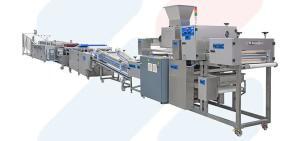
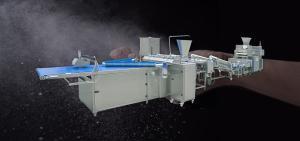
The continuous production process with automatic yufka and mantı lines begins in the automatic yufka lines when the dough ball is placed into the feeding unit. The dough ball then passes through rolling cylinders to reach the desired thickness. In mantı lines, as the rolled-out dough moves along the conveyor belt, the filling is automatically dispensed, and molds seal and cut the dough. In our Mateks lavash lines, production proceeds from start to finish without human contact; once the dough is placed on the conveyor belt, no operator intervention is required at any point until baking.
At the frozen food sector, this process offers an additional benefit. The faster the product is shaped and sent to the shock-freezer, the smaller the ice crystals remain, and the less water is lost during thawing. On a slow, manually operated line, where the dough sits at room temperature, this advantage is lost.
The Advantage of Standardization in Industrial Dough Sheeting Machines
Standardization is a priority that takes precedence over quality in frozen products. This is because customers only evaluate a frozen product once they’ve cooked it at home, and by that point, you have no chance to make corrections. The primary advantage of standardization in industrial dough sheeting machines is maintaining a consistent thickness.
Industrial dough sheeting machines maintain thickness at the micron level. A sheet rolled out to 0.8 mm will still be 0.8 mm thick even after the line has been running for ten hours. This consistency serves two purposes: ensuring weight consistency during packaging and ensuring that all products brown in the same amount of time during baking. In a manual kitchen, it is unrealistic to expect the same chef to maintain the same thickness for eight hours straight.
There is also the issue of waste. When thickness is consistent, the cutting plan becomes fixed, and edge scraps can be accurately calculated. At a facility scale, even a small difference in waste translates into a significant annual expense in flour costs. All this standardization not only increases customer satisfaction but also reduces operating costs.
Smart Conveyor and Feeding Systems That Reduce Labor Costs
In dough production, labor costs typically accumulate not at the machine itself, but between machines—hands moving products from one workstation to another, collecting items that fall off the belt, or waiting in line. Conveyor and automatic feeding systems eliminate precisely these intermediate tasks.
Our Mateks machines maximize your profits and productivity with smart conveyor and feeding systems that reduce labor costs. When the dough exiting the opening unit moves automatically to the next station, there is no longer a need for personnel working between those two points. These workers can then be reassigned to high-value-added tasks such as quality control or packaging.
Capacity figures make this picture even clearer. Although some of our lines are designed to run on standard household electricity, they can produce up to 3,600 units per hour. When you consider the number of people required to perform the same task manually, the system’s payback period falls below one year in most facilities.
Machine Selection Criteria for Frozen Food Facilities
The most common mistake in machine selection criteria for frozen food facilities is focusing solely on hourly capacity. Capacity is important, but there are three other criteria that are just as critical in a frozen food facility: compliance with food regulations, ease of cleaning, and flexibility to expand the product range.
The following headings outline the questions that should be asked of a supplier before making an investment decision.

Stainless Steel Design and Hygiene Compliant with Food Standards
It is not a preference but a requirement that every surface in contact with dough be made of food-grade stainless steel. Stainless Steel Design and Hygiene Compliant with Food Standards is an element that must never be overlooked. 304-grade stainless steel is corrosion-resistant, unaffected by the dough’s acidic content, and resistant to aggressive cleaning chemicals.
The real difference lies in the design details: rounding the inner corners to eliminate blind spots, ensuring belts and mechanisms can be removed and installed with one hand, and allowing cleaning water to drain from the machine without pooling. Hygiene is critical in frozen food production because, while bacterial growth stops in a flash-frozen product, it does not disappear; in fact, any contaminated microorganisms return once the product thaws. That is why we place particular emphasis on the easy removal of belts and effortless cleaning of the machine in Mateks machines.
Creating Product Diversity with Interchangeable Mold Systems
A facility that produces a single product remains vulnerable to market fluctuations. Interchangeable die systems, however, mitigate this risk by allowing you to produce multiple products from the same machine body. This is why creating product diversity with interchangeable die systems is so important.
In the case of mantı, this is evident in the variety of shapes available. In addition to classic four- and six-pocket mantı, you can produce different varieties such as rose mantı, pelmeni, and soy-filled mantı using a single mantı machine. When you change the mold, the product changes; you don’t have to make a new investment from scratch.
This flexibility pays off directly on the frozen food shelf. When you need pelmeni for the domestic market, rose-shaped mantı for export, or products in different weights, simply changing the die set is sufficient—there’s no need to set up the line from scratch.
Mateks Machine Dough Production Systems
At the Mateks Machine production facility, we manufacture baklava, borek, mantı, lavash, and dough-making machines all under one roof. Our more than 5,000 completed projects and exports to over 80 countries stand as the most important proof that our machines operate effectively across diverse culinary cultures and at various scales. The product groups we offer for frozen food producers provide a wide range of alternatives. Our production lines for kol böreği, sigara böreği, and su böreği; our mantı machines ranging from four- to six-chamber models to gül mantı; our standard and mini baklava machines; our lavash lines producing thousands of pieces per hour; our horizontal mixers; our triangular phyllo dough cutting machines; and our pasteurization machines that extend shelf life… Virtually every step a facility needs before blast freezing is covered within these categories. To discuss which machine is right for your facility, you can review our product catalogs or contact our team directly.

The images in this content were generated using artificial intelligence and are intended solely for promotional and visual presentation purposes. Please contact us for details about actual products and services.