Capacity, Weight, and Cost of Stuffed Meatball Machines
As is the case with many dough production facilities and processes, the main factor slowing down the stuffed meatball production process “contrary to popular belief” is not the dough or the filling, but generally the shaping stage. An expert craftsman can produce an average of about 450 stuffed meatballs per hour. However, this number is not fixed or consistent. It drops significantly due to factors such as fatigue or unexpected tasks. This is precisely why industrial-grade stuffed meatball machines are manufactured: to ensure standard size, standard quantity, and standard taste.
Below, we’ve explained with numbers exactly how details such as capacity, weight, and cost are actually calculated in stuffed meatball machines, what the weight setting depends on, and how long it takes for the machine to pay for itself.
What Is a Stuffed Meatball Machine and How Does It Work?
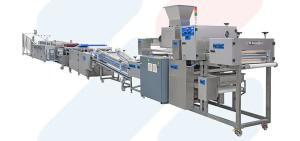
As is well known, stuffed meatballs consist of an outer dough layer and an inner filling. Stuffed meatball machines are designed to prepare and fill these two layers in the correct proportions. These machines operate on the principle of co-extrusion. The ingredients, located in two separate hoppers, are combined in a shared die using the appropriate attachments. Of course, this production line includes many details such as product conveyance channels, cutting units, and sealing nozzles. At the end of the process, the desired product is produced.
While this machine-based production may seem quite fast and simple, the manual process is quite challenging and time-consuming. First of all, there are many details to consider, such as ensuring the dough doesn’t tear, distributing the dough evenly, maintaining a consistent moisture level, mixing the filling ingredients correctly, and adding the correct amount of filling. And the risky part is that all of these must be controlled by the person doing the work.
Furthermore, stuffed meatball machines can also be used to produce falafel, croquettes, kömbe, filled cookies, and similar stuffed products with just a minor mold change. For businesses that do not limit themselves to a single product, this is a feature that directly impacts the return on investment.
Unit Structure and Operating Principle of the Mateks Stuffed Meatball Machine
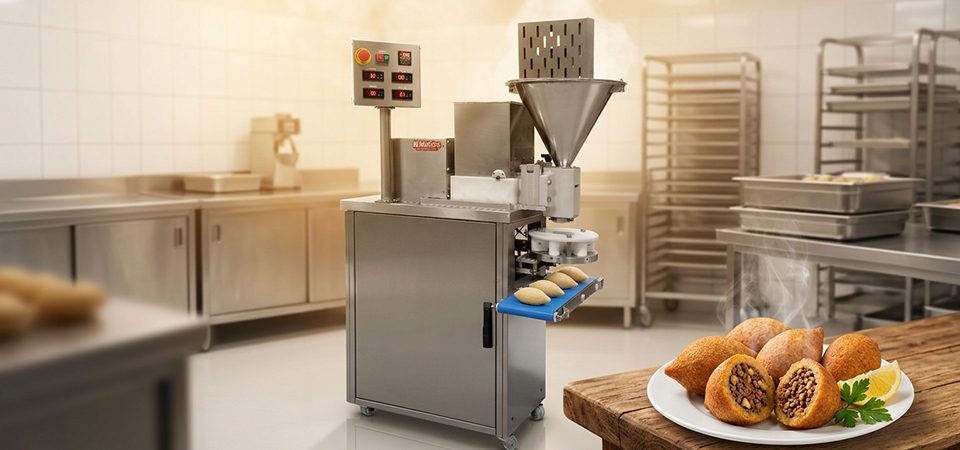
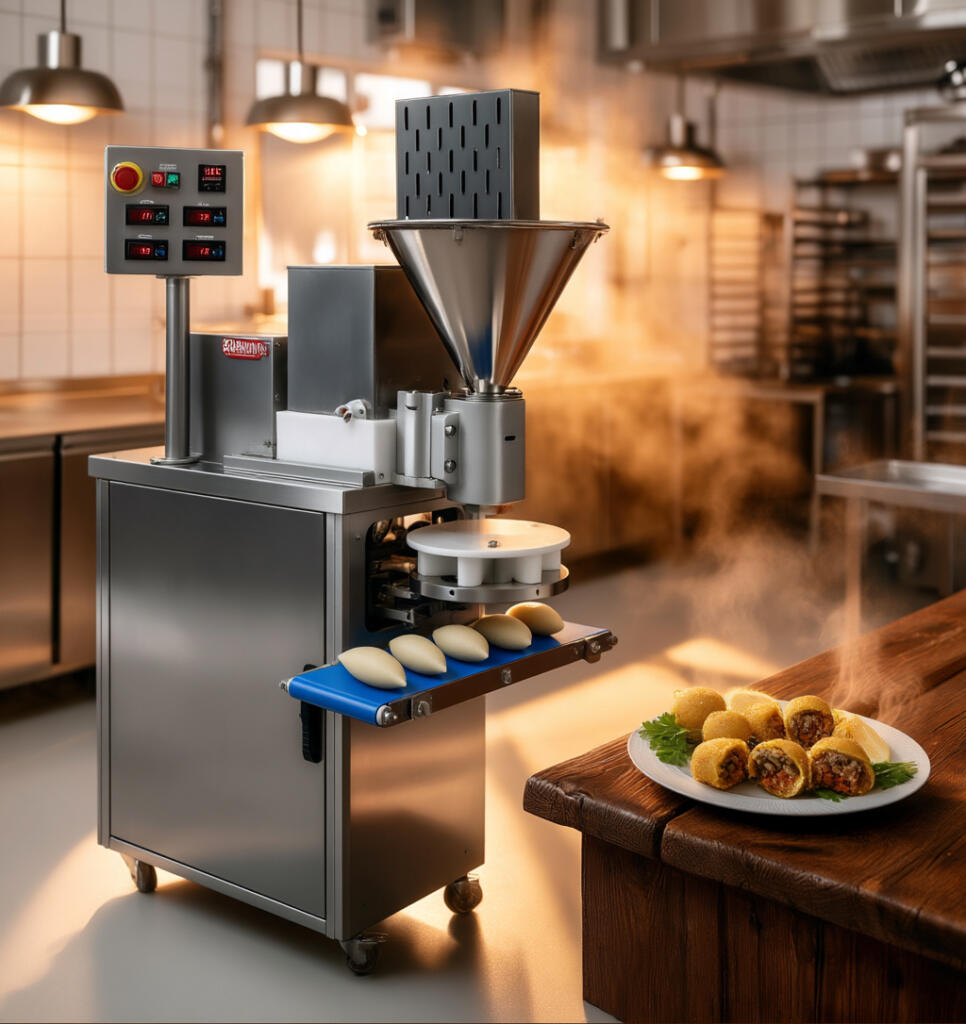
As with many stuffed meatball machines, the unit structure and operating principle of the Mateks Stuffed Meatball Machine are similar. The food-grade stainless steel dough hopper and filling hopper are filled separately. While the dough is conveyed to the molds via a helical system in the desired shape, the filling is dispensed into the center of the dough using pumps within the system. This ensures that both the dough thickness and the amount of filling remain consistent. The cutting unit, which is the next stage in the production process, can be mechanically adjusted. This feature allows for changes in the desired weight without even having to remove the mold.
In addition to all this, Mateks stuffed meatball machines are specially designed to maintain the highest level of hygiene. Every part that comes into contact with food is made of food-grade stainless steel. Furthermore, all these surfaces are designed to be removable. This makes both part replacements and cleaning much more practical. It’s important to remember that the most critical factor in the food industry is not production volume or speed, but the hygiene of the products and equipment.
How Many Industrial-Grade Stuffed Meatballs Does a Machine Produce Per Hour?
Machines on the market generally operate within a production range of roughly 800 to 3,000 pieces per hour. The reason for such a wide range is that capacity depends more on the weight of the product being produced than on the machine itself.
The figures in the catalog are always based on the smallest weight. A machine that produces 1,500 pieces of 20-gram mini stuffed meatballs will produce fewer than 1,000 pieces of a 60-gram portion-sized product. Therefore, when making an investment decision, the key factor to consider is not the number of pieces but how many kilograms of product are produced per hour.
It is also important to understand that machine capacity is not the same as line capacity. Therefore, the answer to the question “How many pieces does an industrial-grade stuffed meatball machine produce per hour?” is determined by the slowest link in the chain “whether it’s dough feeding, filling preparation, tray loading, or shock-freezing” and the daily output is set by that link’s capacity.
Mateks Stuffed Meatball Machine Hourly Production Capacity
The hourly production capacity of the Mateks Stuffed Meatball Machine varies depending on the weight. It shapes products ranging from 10 to 150 grams, and its hourly capacity ranges from 1,000 to 1,500 pieces. As the weight increases, the number of pieces per hour decreases, while output in kilograms increases.
Capacity is determined by the dough feed rate. If you place a mixer that kneads 25 kilograms of dough per hour in front of a machine that produces 1,400 pieces per hour, the machine will be forced to wait constantly. This is generally the most common planning mistake made by businesses.
Dough for bulgur-stuffed meatballs is a denser and less elastic material than regular bread dough. Consequently, vertical mixers struggle with this consistency; they heat the dough, and the heated dough sticks to the mold as it passes through. Horizontal mixers are preferred for bulgur dough because they limit the rise in temperature during kneading. The correct ratio is simple: the amount of dough the mixer prepares in a single batch must cover at least 45 minutes of the machine’s production. Otherwise, the operator will spend half the shift just filling the hopper.
How Are Weight and Shell Thickness Adjusted on a Stuffed Meatball Machine?
The frequency of the weight-cutting unit determines the crust thickness, while the flow rate of the dough and filling pumps also affects it. The two operate in tandem. When you increase the filling flow rate, the crust becomes thinner even if the total weight remains constant.
For manufacturers serving the retail sector, weight tolerance is a legal issue. For example, if the total weight of the 14 stuffed meatballs in a package labeled “500 grams” consistently drops to 480 grams, the problem lies not with the machine but, more often than not, with fluctuations in the dough’s moisture content throughout the shift. Drier dough occupies less volume.
In practice, the desired range for crust thickness is 2 to 3 millimeters. A thinner crust means more filling and lower costs. However, when the crust falls below 2 millimeters, the rate of bursting during frying increases significantly. This results in a loss rather than a profit. A thicker crust, on the other hand, extends the cooking time and is perceived by consumers as a doughy product. For this reason, maintaining this ratio is of great importance. That is why the weight and crust thickness in meatball machines are generally adjusted according to this ratio.
Production and Die Selection in Mateks Machines
Mateks machines allow production ranging from 10-gram “cocktail-size” to 150-gram “large-size” meatballs on the same machine body. The transition between sizes is achieved by changing the mold, and for an experienced operator, this process takes no more than 10 minutes.
The commercial advantage of this flexibility is as follows: Using the same machine, a business can produce 60-gram products for the HORECA channel in the morning and 30-gram products for retail packaging in the afternoon. Instead of investing in two separate machines, production can be carried out for two distinct sales channels. This capability—enabled by production and mold selection in Mateks machines—offers a significant advantage, particularly for businesses experiencing seasonal fluctuations in demand.
What Should Be Considered in Frozen Stuffed Meatball Production?
In the food industry, especially with frozen products, hygiene and quality are of utmost importance. Defects that go unnoticed in fresh products become apparent in frozen production. Flash-freezing can turn even the slightest tension in the outer layer into a crack. So, what should be considered in the production of frozen stuffed meatballs, a product that is widely loved and consumed?
- The most common issue is the fine cracks seen in some products after shock freezing. This is usually caused by the dough having too high a moisture content. As the water in high-moisture dough freezes, it expands and puts pressure on the shell from the inside.
- The size of the bulgur grains also has the same effect; the bulgur becomes the starting point for the crack.
- The waiting time between shaping and flash-freezing is quite important. If the product sits on the tray for 40 minutes, its surface dries out. The dried surface loses its flexibility during flash-freezing. It is crucial to keep the distance and time between these two stations in the production line as short as possible.
- Another important detail is keeping the production line clean. Bacteria tend to multiply rapidly after being frozen and thawed. Therefore, implementing strict hygiene standards from the very beginning will prevent these issues.
- For more detailed information, you can also check out our article on dough production systems in the frozen food industry.
What Determines the Price of a Stuffed Meatball Machine, and When Will the Investment Pay Off?
This is perhaps the most frequently asked question regarding the dough production sector. The main factors determining the price are: capacity, level of automation, number of mold sets, and the quality of the machine body material. Even if two machines appear to have the same capacity on paper, there can be a significant price difference between them. This difference is usually due to the thickness of the stainless steel and the brand of the motor and drive.
For this reason, making an investment decision based solely on the list price is a mistake. There are other factors that must be taken into account. For example, additional die sets, operator training, a stock of critical spare parts, annual maintenance, and how quickly service can reach you.
To answer the questions “What determines the price of a meatball machine?” and “When will the investment pay off?”, the payback calculation is structured as follows: When a machine capable of producing 1,250 meatballs per hour replaces two workers who produce 450 per hour, you add up the monthly savings on labor costs and the profit from reduced waste, then divide that total by the machine’s cost. For medium-sized businesses, the payback period is typically between 12 and 24 months. For companies engaged in contract manufacturing or exporting, this period is even shorter, as the weight standards provided by the machine open the door to new customers.
Frequently Asked Questions
How many kilograms does a stuffed meatball machine produce per hour?
The answer depends on the weight. With the Mateks stuffed meatball machine, 20-gram products yield approximately 30 kilograms per hour, while 60-gram products yield over 60 kilograms.
Does the machine produce only stuffed meatballs?
No. By changing the mold, it can also produce stuffed products such as falafel, croquettes, kömbe, kerebiç, and stuffed cookies.
Can flour-based dough be used instead of bulgur?
Yes, it can. Since flour-based dough is more elastic, it passes through the mold more easily than bulgur-based dough.
How long does it take to clean the machine?
Since the parts that come into contact with food are removable, standard end-of-shift cleaning takes between 20 and 30 minutes.
Is it suitable for producing vegetarian or gluten-free products?
Yes, it is. When the dough recipe changes, the mold and flow rate settings are readjusted; there are no mechanical limitations.